For anyone who spends even the briefest period of time in the Middle East, it quickly becomes apparent that music is hugely important to the people here. Obviously, five times a day there is the songlike call to prayer, but otherwise, wandering through Damascus you are confronted with a whole host of sounds blasting from cars, houses and cafes. Some is familiar (50 Cent, Metallica, Pussycat Dolls) but much of it isn’t.
The single most heard singer in Syria remains, probably, the iconic
Fairouz and this is not just among middle-aged people. However, there is far more to the contemporary music scene here than just this classic torch singer. For example, there is a small
Arab hip hop scene with groups such as MTM (Egypt), DAM (Palestine), Rayess Bek and Kitaayoun (both Lebanon) growing in popularity, and there is also a small rock/metal scene. However, these homegrown hip hop and metal scenes are still fairly underground, and hard to penetrate for outsiders [the metal scene, in particular, has fallen victim to a clampdown by the state].
Far more visible, and far more popular, are the Arabic pop stars. These are the stars who are dominating the TV screens in cafes and the covers of the showbiz magazines, whose posters are for sale in the souq, and whose hits are filling the dancefloors of the clubs in Damascus.
Many of this industry’s characteristics are familiar from other pop music forms across the world. For example, there is clearly an emphasis on style over substance. Marketing is largely through videos (known as clips), aired on satellite channels which escape censorship and which, to a large degree, tend to present provocative, sexualised images of the stars to promote their songs (after all, sex sells!). There is also a tendency to seek deals with other products (e.g. soft drinks, fashion houses etc).
The industry is dominated by a small number of pan-Arab production houses (e.g. Rotana: based in Dubai, Saudi financed and drawing heavily upon Lebanese creative talent), and has its fair share of svengali figures with a Pygmalion hold over their young starlets.
The music is a mix of traditional Arab instruments (e.g. ney (flute), oud (lute), qanun (zither), darabuka (drum) plus violins which have been a feature of Arabic music since the mid-19th Century), and modern instruments (e.g. electric guitar, programmed beats, synthesisers). It also combines indigenous Arabic rhythms and tones with an array of other influences (e.g. Indian, Carribean, Latin American, Western) to produce a rich blend of fast percussive beats and saccharine layers of melody.
This manufactured sound is matched by the stars' manufactured images: with their surgically enhanced physiques, whitened skin and teams of stylists and make-up artists they represent unattainable levels of physical perfection. This is augmented through the videos portraying the stars in glamourous locations (e.g. Paris or Prague) and in melodramatic and romantic situations.
One of the interesting features of the clips is their postmodern willingness to mix and match from amongst a diverse range of cultural influences (from Fellini to 'Flashdance', from modern R'n'B's bling to the sepia-tinged classiness of the Egyptian cinema of the 1940s and 1950s).
Therefore, this music is clearly uniquely Middle Eastern, yet it happily interacts with, and draws upon developments and traditions from outside its geographical and cultural borders (but this doesn't stop 90% of it from being, to these ears, overproduced and overpackaged nonsense!).
So here, for your information, are some brief profiles of a few of the more noteworthy female stars who are currently ubiquitous in Syria - note the domination of Lebanese stars. My apologies to Amr Diab, Iwan and all the other pop music studs, but for now I'm gonna concentrate on the laydeez: here are the current princesses of Arabic pop...

Elissa (Lebanon) – Elissa Khoury was born in Lebanon in 1972. As with so many Arabic pop stars Elissa graduated to music through singing on TV and, since releasing her debut album in 1998 she has released a series of best-selling albums.
Her big breakthrough came in 2002 with the album 'Ayshalak' (Elissa’s third) which sold almost 3 million copies. The ‘daring’ video of the title track (‘I Live For You’), in which the singer is seen remembering/fantasizing about a sexual liaison, was shot in Paris by the famous French director Fabrice Begotti, whilst Elissa’s wardrobe and make-up were provided by Christian Dior.
Her subsequent albums have all sold in the millions, and since 2004 Elissa has been part of Rotana’s all-conquering roster of artists.
Elissa is an official spokesperson for Pepsi. In 2006 she co-starred in a commercial alongside Christina Aguilera. Her song 'Arrably' was used to advertise Pepsi X. She has also appeared in the first season of the Arabic Star Adademy. A more dubious claim to fame is the fact that she duetted with Chris De Burgh on his 2002 single ‘Lebanese Nights.’
Elissa’s current album, 'Bastanak', which was released earlier this year, is even outselling all her previous efforts (3.7 million and rising), and the videos are on constant rotation proving her status as one of the biggest stars in the region.
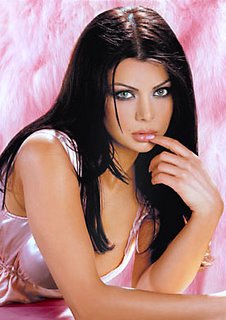
Haifa (Lebanon) – Haifa Wehbe is the most popular of a new breed of "bad girl" performers (alongside Nagla, Marwa and others). Her good looks make her unpopular amongst many girls, but this hasn’t stopped her latest video, 'Boos El Wawa', from joining her previous releases at the top of the satellite TV playlists.
Haifa grew up in Beirut and became a model at a very young age, being crowned "Miss South Lebanon" at age sixteen. She got into the music industry largely through her modelling and acting, releasing her debut album in 2003.
In 2005 Haifa starred in the pan-Arab reality TV show El Wadi (‘The Valley’) – kind of like an Arabic Celebrity Big Brother - which featured weekly performances from Ms Wehbe in which she aired material from her second album Baddi A’ish (I Want To Live).
Unsurprisingly, Haifa’s private life has been the subject of much scrutiny: in particular her on-off engagement to Saudi businessman Tariq Al-Jaffali, alleged amateur porn videos with an ex-boyfriend and her troubled relationship with her sister Rola have all been fodder for the Middle Eastern media.
Although she is not widely regarded as a talented singer, she is undoubtedly a popular performer, especially among a young male audience for whom she is widely regarded as the ultimate sex symbol.
On June 10th Haifa was the support act for 50 Cent when he played at the Beirut International Exhibition and Liesure Center (BIEL). She can currently be seen across the Arab world starring alongside Thierry Henry (Arsenal, France) in a World Cup tie-in commercial for Pepsi.

Nancy (Lebanon) – Nancy Ajram is arguably the most popular performer in the Arab world at present. She made her TV debut at the age of 14, when she won a TV talent contest with her performance of a song by the legendary Egyptian singer Umm Kulthum.
In 2003, Nancy hit it big with Akhasmak Ah ('I'm Not Talking To You'), taken from her third album 'Ya Salaam'. In part the song's popularity was due to its video which portrayed the singer as a cafe manager who entertained her male clientele with her singing and dancing (reminiscent of Brigitte Bardot's role in 'And God Created Woman').
This shift from child prodigy to adult star was accompanied by a corresponding change in image involving expert stylists, make-up artists, cinematography and also cosmetic surgery - Ajram has admitted having her nose altered through surgery. Nancy herself is very aware of the importance of the right packaging: "We're in the image age, the first thing people notice are the singer's looks and apparel. They notice the voice second, though I believe it is the most important factor, however you cannot ignore presentation, and this includes hair, makeup and clothes."
Although her image is more innocent and wholesome than the likes of Haifa or Ruby, Nancy has still fallen foul of more conservative elements in the region. Most dramatically, in October 2003, there was a riot outside one of her concerts in Bahrain when protesters from a number of religious opposition parties attacked fans because they objected to such an event being held during the holy month of Ramadan.
Nancy and her management have always been savvy with their commercial deals. For example, she recently appeared in a Coca Cola commercial that employed her song 'Mo'gaba, Moghrama' ('An Admirer, A Lover). Another of Nancy's songs from her new album ('Ana Yalli Bhebbak') features in a diamond jewellery advertisement for Damas. Certainly, these deals have not hindered the success of Nancy's latest album, 'Yatabtab...Wa Dalla', the best seller of 2006 so far, having shifted 5 million copies.

Ruby (Egypt) – Rania Hussein (born in 1981 in Cairo), known as Ruby, is an Egyptian model, actress and singer, famous for her raunchy music videos and sexy image. She is the protégé of the Egyptian director, Sherif Sabri, her manager, who also produced her debut album .
Ruby shot to fame in the summer of 2003, when her song Enta Aref Leih (‘You Know Why’) was a hit on satellite TV. The video featured the singer as a belly dancer gyrating her way through the streets of Prague. Her subsequent hits have all featured similarly provocative videos.
This has led to her having run-ins with conservative authorities across the Middle East, for example, in the summer of 2004 the singer was threatened with legal action by the Egyptian Syndicate of Musical Professions, a dispute only resolved once the singer had made a hefty donation and was accepted as a member. Also in 2004, Ruby faced an unsuccessful campaign by conservatives in Jordan to prevent her from entering the country to perform a couple of sold-out concerts.
Despite (or perhaps because of) her controversial image, a 2005 poll by Al-Hayat concluded that Ruby was more popular than any political or intellectual figure in Egypt.
Ruby: "I'm not writing my own songs yet, but I'm not controlled by anyone. I'm shaping my own style, my look and my music.”
[Thanks to 3arabiavideo.com for the pics and some of the information.]