Tuesday 18th April 2006
In the morning C-lo and I departed Damascus with four friends for a three day trip to the north of Syria. In late morning we arrived in Homs – Syria’s unloved third city – where we hired a taxi and driver for the day. As we departed for the Crusader castle Krak Des Chevaliers we were holding our breaths – partly at anticipation at seeing one of the most majestic and best preserved Medieval castles in the world, and partly because the six of us were crammed into four car seats!
Our first stop was at St George’s Monastery, located on a hilltop opposite Da Krak. Aside from affording us good views of the main attraction, it was an interesting visit in its own right – the site of a 6th Century church, though the existing churches date back to the 13th and 19th Centuries respectively. There were some fine icons and wood carvings.

Then it was time to visit the Krak and none of us were disappointed. It is an impressive piece of military architecture, labyrinthine in its complexity with many passageways tantatisingly leading down into the darkness into who-knows what crypts and catacombs. Above ground there remains a relatively well-preserved mix of Gothic, Romanesque and Arabic building styles (the Crusaders surrendered the castle to the Mamluks in 1271). It was quiet – just a large group of Spaniards and a handful of other tourists - and aside from the T-Shirt hawkers and self-appointed guides we were left alone to explore at our leisure.

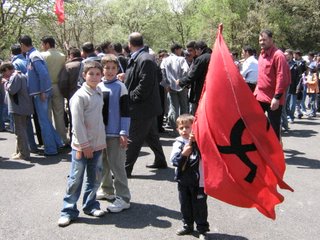
On the way up and down to the castle we passed through a small hillside village where the locals were friendly and fascinated by us (some children shouted ‘Come and look at the beautiful foreigners!’). We accepted the inevitable offer of a super sugary tea from a weathered man wearing a kufeyya (traditional black/white or red/white head-dress). He chatted to us in Arabic about the village (‘Muslims and Christians here are like one family’) and the local trails and shrines for about half an hour until the sugar had kicked in and it was time for us to hit the road again.
 We spent the evening in the city of Hama. Compared with Damascus it felt more chilled and airy. This was particularly surprising given the trauma suffered by the city in February 1982 when an insurrection led by the Muslim Brotherhood was crushed, killing thousands. The only clue to this bloody moment in the recent past is the visible lack of old buildings in the heart of the city – during the fighting almost all the Old City was destroyed.
 But these events seemed very distant as we dined on the banks of the Orontes, serenaded by scores of frogs, and wandered through the city centre souqs, greeted by abayya-clad ladies and teenaged bicylists alike.
 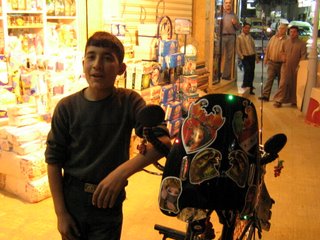 I got the impression that not many foreigners spent much time here, which is a shame. If we get the chance I’d like to go back.
Wednesday 19th April 2006
Today our road trip moved onto Aleppo – Syria’s second city with a population of about 3 million, and currently Islamic Capital of Culture 2006. The heart of the city is the Citadel which stands on a commanding position atop a tell overlooking the Old City. It is an impressively imposing structure dating back to the 12th Century, and houses 2 mosques, a palace, and a modern facsimile of a Roman amphitheatre. We spent many hours up there enjoying the quiet and calm in the late afternoon sunshine.
 The interior of the Citadel was a world away from the heat, smells and bustle of Aleppo’s souqs. The covered markets stretch for miles and are rightly famed throughout the Middle East. We were on the hunt for some fabrics for C-lo but a mixture of fatigue and the onset of Delhi belly put a premature end to our visit.
As I sat over the hole I was able to ponder the ways that Aleppo differed from Damascus - the better condition of the Old City in Aleppo (thanks in part to World Heritage status and German expertise), the fewer numbers of stray cats (there are thousands all over central Damascus), the absence of the Lambada... (when cars reverse in Damascus, chances are that they'll end up emitting a weedy electronic version of the Lambada. But this seems to be a regional preference cos whereas I hear the Lambada dozens of times a day back in Damas, I barely heard it in Aleppo - the drivers there were mainly rocking to an ice-cream van version of 'It's a Small, Small World').
Thursday 20th April 2006
We left Aleppo early on a two and a half hour bus ride down to the town of Musyaf – the location of the legendary mountain stronghold of the Old Man of the Mountains, leader of the Nizari Ismaili sect popularly known as the Assassins. However, the reality proved to be far less mysterious than the myth – whilst the tales of the sect’s drug-fuelled debauchery were undoubtedly the product of overblown Western imaginations, the castle was pretty disappointing – it looked solid enough but hardly impregnable and certainly paled in comparison to the great Krak.
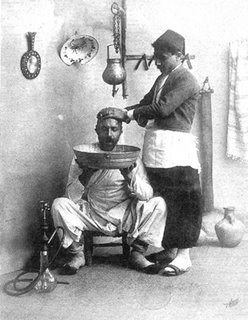
 However, the main purpose of our trip here was not to see sights, it was to eat! We enjoyed the hospitality of my housemate’s sister who had called in her mum as reinforcements to help prepare a feast for us. After the umpteenth course of food (‘Kul!’ – ‘Eat!’), the customary session on the nargileh (water pipe), and a shared glass of arak with her husband, we were all feeling ready to pass out, sitting dozily on the balcony looking out over the ugly concrete town and the beautiful green rolling hills behind.

The pit-stop at Musyaf gave us fuel for an epic oxygen-starved 3 hour bus-ride back to Damascus. It was a relief to be dropped off amongst the noise and dust that is becoming so familiar, not least because my guts were starting to be in full rebellion. After some time glued to the hole in the floor which we optimistically call a toilet I decided to put off the planned trip to Beirut for another occasion.

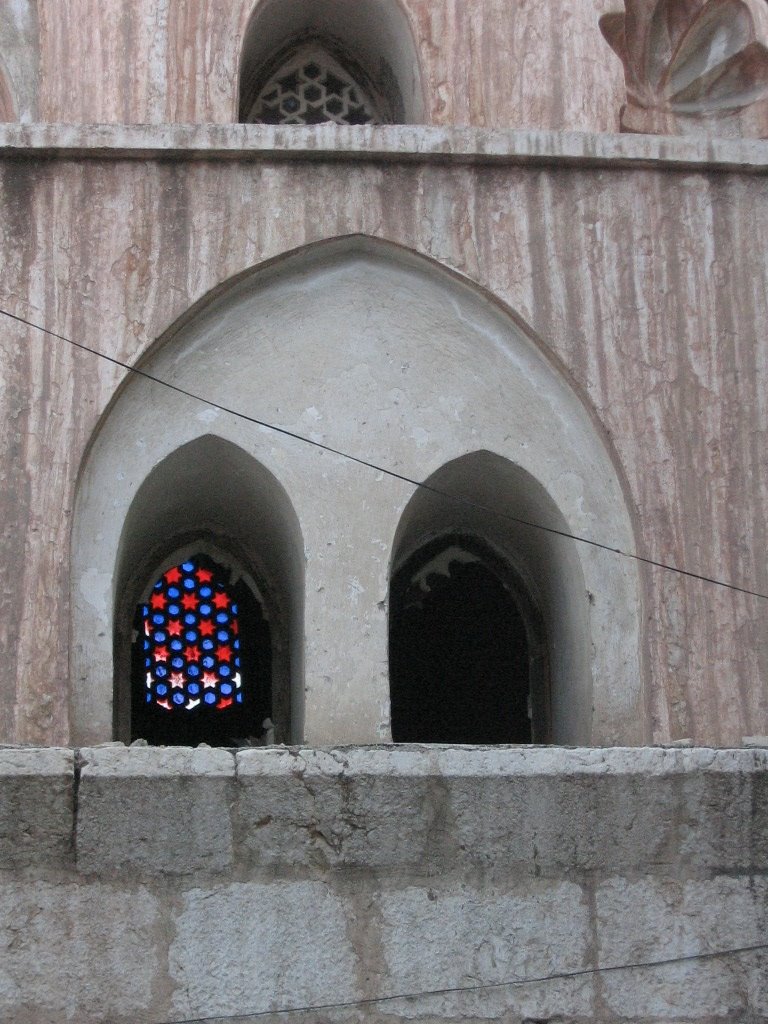
 In the evening we met some friends and had dinner at the top of the hill, where we admired the lights of the city stretching out to the horizon.

 Then it was time to visit the Krak and none of us were disappointed. It is an impressive piece of military architecture, labyrinthine in its complexity with many passageways tantatisingly leading down into the darkness into who-knows what crypts and catacombs. Above ground there remains a relatively well-preserved mix of Gothic, Romanesque and Arabic building styles (the Crusaders surrendered the castle to the Mamluks in 1271). It was quiet – just a large group of Spaniards and a handful of other tourists - and aside from the T-Shirt hawkers and self-appointed guides we were left alone to explore at our leisure.
 On the way up and down to the castle we passed through a small hillside village where the locals were friendly and fascinated by us (some children shouted ‘Come and look at the beautiful foreigners!’). We accepted the inevitable offer of a super sugary tea from a weathered man wearing a kufeyya (traditional black/white or red/white head-dress). He chatted to us in Arabic about the village (‘Muslims and Christians here are like one family’) and the local trails and shrines for about half an hour until the sugar had kicked in and it was time for us to hit the road again.
 We spent the evening in the city of Hama. Compared with Damascus it felt more chilled and airy. This was particularly surprising given the trauma suffered by the city in February 1982 when an insurrection led by the Muslim Brotherhood was crushed, killing thousands. The only clue to this bloody moment in the recent past is the visible lack of old buildings in the heart of the city – during the fighting almost all the Old City was destroyed.
 But these events seemed very distant as we dined on the banks of the Orontes, serenaded by scores of frogs, and wandered through the city centre souqs, greeted by abayya-clad ladies and teenaged bicylists alike.
  I got the impression that not many foreigners spent much time here, which is a shame. If we get the chance I’d like to go back.
 The interior of the Citadel was a world away from the heat, smells and bustle of Aleppo’s souqs. The covered markets stretch for miles and are rightly famed throughout the Middle East. We were on the hunt for some fabrics for C-lo but a mixture of fatigue and the onset of Delhi belly put a premature end to our visit.
 However, the main purpose of our trip here was not to see sights, it was to eat! We enjoyed the hospitality of my housemate’s sister who had called in her mum as reinforcements to help prepare a feast for us. After the umpteenth course of food (‘Kul!’ – ‘Eat!’), the customary session on the nargileh (water pipe), and a shared glass of arak with her husband, we were all feeling ready to pass out, sitting dozily on the balcony looking out over the ugly concrete town and the beautiful green rolling hills behind.
 The pit-stop at Musyaf gave us fuel for an epic oxygen-starved 3 hour bus-ride back to Damascus. It was a relief to be dropped off amongst the noise and dust that is becoming so familiar, not least because my guts were starting to be in full rebellion. After some time glued to the hole in the floor which we optimistically call a toilet I decided to put off the planned trip to Beirut for another occasion.
 When we arrived at 8 in the morning it was packed with people, starting cooking fires and reclaiming their territory. However, our uncommunicative mini-bus driver refused to acquiesce in our desire to explore the site. Instead, after an exasperating and seemingly aimless hour-long drive around the countryside we were dropped off at a scenic spot in the foothills where we set up our picnic.